
YEAR

2026年

  • 2026年9月9日
  • 2026年9月9日

Our collaborative study with the Maeshima lab at the National Institute of Genetics has been published in Nature Genetics!

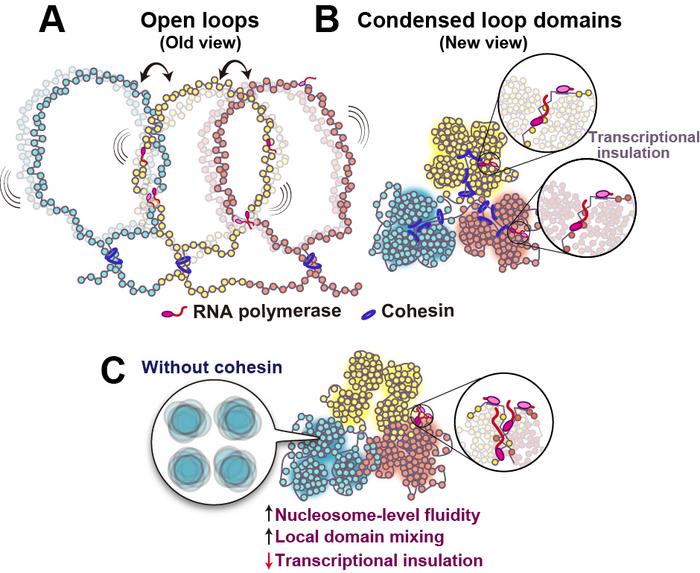
Our collaborative study with Professor Kazuhiro Maeshima’s laboratory at the National Institute of Genetics was published in Nature Genetics on September 8, 2026. Using imaging approaches in living human cells, the study revealed that transcriptionally active euchromatin forms condensed domains. It further showed that cohesin constrains chromatin motion within these domains and prevents neighboring domains from mixing. From our laboratory, Assistant Professor Yoshiaki Kobayashi and Professor Hiroshi Ochiai contributed to visualizing nascent RNA and analyzing simultaneous transcription of spatially proximal genes using intron-seqFISH. This analysis showed that cohesin depletion increased the frequency of simultaneous transcription between nearby genes. These findings suggest that the structure and dynamics of chromatin domains help maintain transcriptional independence between genes. Read the paper/Press release from the National Institute of Genetics/Press release from Kyushu University (in Japanese) Image credit: Shiori Iida, Sachiko Tamura, Kazuhiro Maeshima, National Institute of Genetics, ROIS. Source: EurekAlert!
  • 2026年2月11日
  • 2026年2月11日

New bioRxiv preprint: Minute-scale coupling of chromatin marks and transcriptional bursts

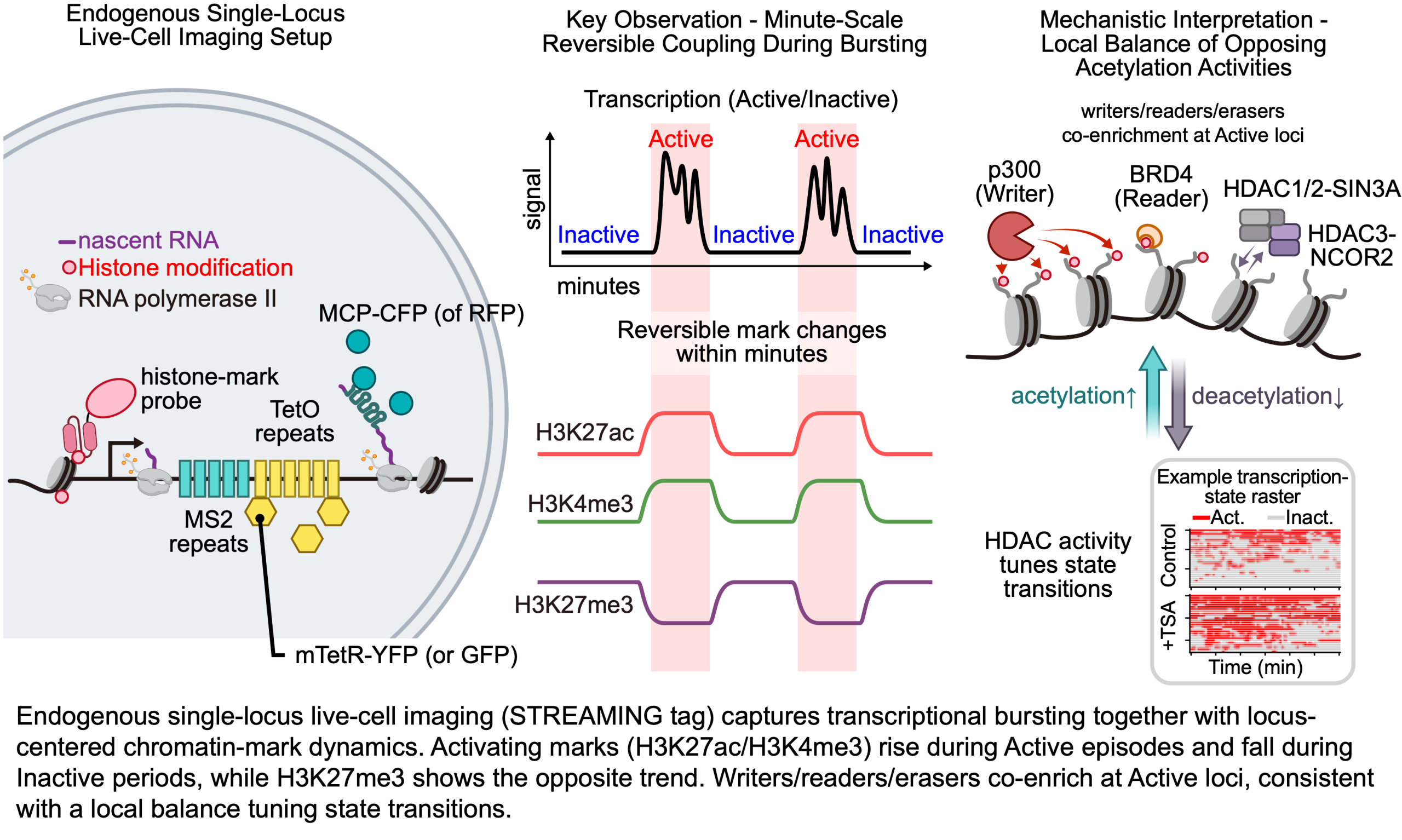
We have posted a new preprint on bioRxiv: “Minute-scale coupling of chromatin marks and transcriptional bursts” (https://www.biorxiv.org/cgi/content/short/2026.02.08.704500v1). In this study, we combine single-gene live-cell imaging at endogenous loci with fluorescent probes for histone modifications (mintbody/ChromID) to capture transcriptional bursting together with locus-centered chromatin-mark dynamics in mouse embryonic stem cells. We find that activating chromatin marks (H3K27ac/H3K4me3) increase during transcriptionally Active episodes and decrease during Inactive episodes, whereas a Polycomb-associated repressive mark (H3K27me3) shows the opposite tendency. We further show that acetylation-related regulators, including selected deacetylase modules, co-accumulate at Active loci, and that HDAC inhibition reshapes Active/Inactive dwell times, supporting a model in which opposing enzymatic activities tune state transitions on minute timescales. This work was led by graduate students Xiohui Gao and Chaebeen Ko, and was conducted in collaboration with Prof. Yasuyuki Ohkawa lab and Prof. Akihito Harada lab (Kyushu University), and Prof. Hiroshi Kimura (Tokyo Institute of Science). We […]