CATEGORY

news

  • 2026年2月11日
  • 2026年2月11日

New bioRxiv preprint: Minute-scale coupling of chromatin marks and transcriptional bursts

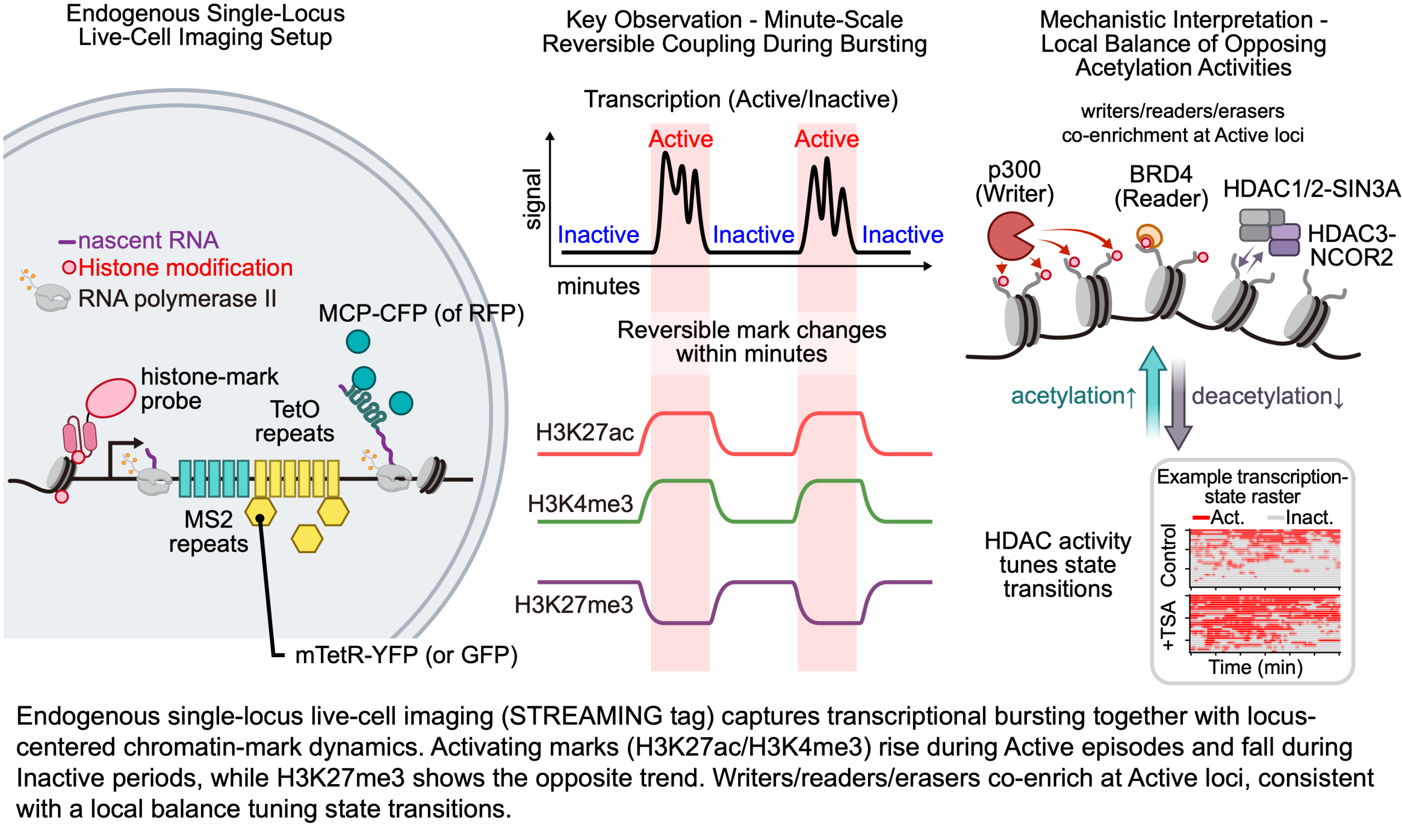
We have posted a new preprint on bioRxiv: “Minute-scale coupling of chromatin marks and transcriptional bursts” (https://www.biorxiv.org/cgi/content/short/2026.02.08.704500v1). In this study, we combine single-gene live-cell imaging at endogenous loci with fluorescent probes for histone modifications (mintbody/ChromID) to capture transcriptional bursting together with locus-centered chromatin-mark dynamics in mouse embryonic stem cells. We find that activating chromatin marks (H3K27ac/H3K4me3) increase during transcriptionally Active episodes and decrease during Inactive episodes, whereas a Polycomb-associated repressive mark (H3K27me3) shows the opposite tendency. We further show that acetylation-related regulators, including selected deacetylase modules, co-accumulate at Active loci, and that HDAC inhibition reshapes Active/Inactive dwell times, supporting a model in which opposing enzymatic activities tune state transitions on minute timescales. This work was led by graduate students Xiohui Gao and Chaebeen Ko, and was conducted in collaboration with Prof. Yasuyuki Ohkawa lab and Prof. Akihito Harada lab (Kyushu University), and Prof. Hiroshi Kimura (Tokyo Institute of Science). We […]

  • 2024年12月8日
  • 2024年12月8日

Our New Paper is Published in Science Advances!

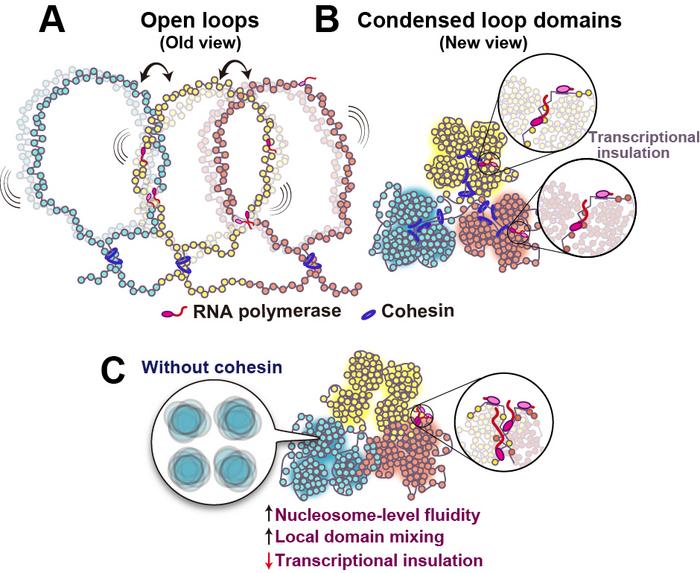
We are excited to announce that our latest research has been published in Science Advances! This study uncovers a novel mechanism by which changes in genomic proximity regulate gene expression dynamics. By utilizing advanced seq-DNA/RNA/IF-FISH technology and polymer dynamics simulations, we revealed how higher-order genome structures behave during transcriptional activation. These findings offer potential applications in gene therapy and drug discovery. Paper Title:“Transcription-coupled changes in genomic region proximities during transcriptional bursting”Journal: Science AdvancesPublication Date: December 6, 2024 Read more about our research here. Please see the press release here.

  • 2024年9月22日
  • 2024年9月22日

A protocol for DNA/RNA/IF-seqFISH image analysis has been published in Methods Mol. Biol.!

The image analysis protocol for DNA/RNA/IF-seqFISH has been published in Methods Mol. Biol. (Computational Methods for 3D Genome Analysis, edited by Ryuichi Nakato)! https://link.springer.com/protocol/10.1007/978-1-0716-4136-1_24#DOI Image Analysis Protocol for DNA/RNA/Immunofluorescence (IF)-seqFISH DataHiroaki Ohishi & Hiroshi Ochiai AbstractImaging-based spatial multi-omics technologies enable the analysis of higher-order genomic structures, gene transcription, and the localization of proteins and posttranslational modifications (PTMs) at the single-allele level. This allows for detailed observation of biological phenomena, including transcription machinery within cells and tissues. This chapter provides an in-depth explanation of the principles behind these technologies, focusing on DNA/RNA/immunofluorescence (IF) sequential fluorescence in situ hybridization (seqFISH). The chapter also offers a comprehensive, step-by-step image analysis protocol, covering aspects such as image preprocessing, spot detection, and data visualization. For practical use, complete Jupyter Notebook codes are available on GitHub (https://github.com/Ochiai-Lab/seqFISH_analysis).

  • 2024年9月12日
  • 2024年9月12日

A collaborative study with the Mat Francois lab (Centenary Institute, The University of Sydney) has been published on bioRxiv!

This research focuses on the complex molecular mechanisms required for stem cells to self-renew, shedding light on the dynamics of the SOX2 transcription factor. Using single-molecule tracking technology combined with the STREAMING-tag transcriptional reporter system, we visualized in real-time how SOX2 clusters form at the Nanog gene locus and their relationship to transcription bursts in embryonic stem cells. The study reveals that SOX2 clustering occurs at different timings from transcription bursts, highlighting distinct roles for SOX2 at various stages of the transcription cycle. https://www.biorxiv.org/content/10.1101/2024.09.10.612363v1 Anti-phase clustering of regulatory factors shapes gene bursting Bitong Li, Yew Yan Wong, Neftali Flores-Rodriguez, Tara Davidson, Matthew S Graus, Valeriia Smialkovska, Hiroaki Ohishi, Angelika Feldmann, Hiroshi Ochiai, Mathias Francois AbstractThe ability of stem cells to divide and self-renew depends on a complex choreography of molecular events that maintain the transcriptional oscillation of pluripotency genes. Only a handful of transcription factors (TFs) are necessary to preserve […]

  • 2024年5月9日
  • 2024年5月9日

A joint research paper with Kyushu University’s Institute of Medical Science, Ohkawa Laboratory, on the spatial omics technology “PECAb” has been published in Nature Communications!

The Ohkawa Laboratory at the Medical Institute of Bioregulation, Kyushu University, has developed PECAbs (Precise Emission Canceling Antibodies) with cleavable fluorescent labels. PECAbs enable high-specificity sequential imaging using hundreds of antibodies, allowing for the reconstruction of spatiotemporal dynamics of signal transduction pathways. Furthermore, by combining this approach with continuous single-molecule RNA-FISH, it is possible to effectively classify cells within human tissues and identify their signal activation states. The PECAb system functions as a comprehensive platform for analyzing complex cellular processes. This content has been published in the journal Nature Communications. Title: Precise immunofluorescence canceling for highly multiplexed imaging to capture specific cell states Authors: Kosuke Tomimatsu, Takeru Fujii, Ryoma Bise, Kazufumi Hosoda, Yosuke Taniguchi, Hiroshi Ochiai, Hiroaki Ohishi, Kanta Ando, Ryoma Minami, Kaori Tanaka, Taro Tachibana, Seiichi Mori, Akihito Harada, Kazumitsu Maehara, Masao Nagasaki, Seiichi Uchida, Hiroshi Kimura, Masashi Narita & Yasuyuki Ohkawa Nature Communications, 15, 3657 (2024) https://www.nature.com/articles/s41467-024-47989-9

  • 2023年11月29日
  • 2024年9月22日

Our lab has just released a new preprint!

Our lab has published a new preprint! It has been observed that in the state of transcriptional activation, distinctive higher-order genomic structures and protein aggregates are formed, furthermore, the viscosity around genes increases, and the interaction time between enhancers and promoters is prolonged. This research was conducted in collaboration with Drs. Hiroaki Ohishi (in our lab), Soya Shinkai (RIKEN), Shuichi Onami (RIKEN), Kazufumi Hosoda (Ansanga Labs), and Yasuyuki Ohkawa (MIB, Kyushu U.)! https://www.biorxiv.org/content/10.1101/2023.11.27.568629v1 Recent imaging analyses have revealed that transcription is a dynamic process that switches between an active state, where genes are continuously transcribed by RNA Polymerase II, and an inactive state where transcription does not occur. This is known as transcriptional bursting and is a universal phenomenon observed across many species and cell types. It has been shown that this transition involves the interaction between enhancers and promoters, as well as the assembly of transcriptional regulatory factors. Transcription […]

  • 2023年9月20日
  • 2023年9月20日

We have been selected for JST CREST (Bio-DX)!

We have been selected for the JST CREST, “Innovation of Life Science through Digital Transformation Focused on Data-Driven and AI-Driven Technologies” (Bio-DX, Research Director: Professor Yasushi Okada). https://www.jst.go.jp/kisoken/crest/application/2023/230919/230919crest.pdf Research Project Title: Understanding the Mammalian Cell Fate Regulation Framework through Multimodal Spatiotemporal Integrated Omics Analysis. The lead researcher is Ochiai from Kyushu University. Main collaborators include Takuya Funatomi (Nara Institute of Science and Technology), Kazumitsu Maehara (Kyushu University Institute of Biodefense Medicine), and Soya Shinkai (RIKEN Center for Life Science Technologies). Research Overview: The process of mammalian development involves numerous stochastic elements and unknown factors, making a detailed understanding of the cell fate regulation mechanism challenging. In this research, we will target the early developmental stages of mice and organoids to analyze the heterogeneity in gene expression between cells, the epigenomic elements that regulate it, and intercellular interactions in a data-driven, multimodal, and spatiotemporal manner, elucidating the cell fate regulation mechanism. […]

  • 2023年6月2日
  • 2023年6月2日

A review article was published in CURRENT OPINION IN STRUCTURAL BIOLOGY

A review article titled “Organization of transcription and 3D genome as revealed by live-cell imaging,” written with Hiroshi Kimura and Yuko Sato of Tokyo Institute of Technology, has been published in CURRENT OPINION IN STRUCTURAL CURRENT OPINION IN STRUCTURAL BIOLOGY.https://doi.org/10.1016/j.sbi.2023.102615It summarizes the relationship between higher-order genomic structure and gene transcription as revealed by live cell imaging.

  • 2022年12月21日
  • 2024年3月28日

Our paper on the “STREAMING-Tag” system for real-time detection of gene activation was published in Nature Communications.

A paper on the “STREAMING-Tag” system, a joint research project led by researcher Ohishi-san and the groups of Prof. Hiroshi Kimura at the Tokyo Institute of Technology and Prof. Yasuyuki Ohkawa at the Medical Institute of Bioregulation, Kyushu University, has been published in Nature Communications.https://www.nature.com/articles/s41467-022-35286-2 In this paper, we established the Spliced TetO REpeAt, MS2 repeat, and INtein sandwiched reporter Gene tag (STREAMING-tag) system that enables highly precise quantification of transcriptional activity and nuclear localization of specific endogenous genes. Using this system and fluorescent protein knock-in to transcription-related factors, we have revealed that specific transcription-related factors form clusters around genes in a transcriptional activity state-dependent manner. This system is expected to contribute to the elucidation of detailed transcriptional regulation mechanisms.